HSAA Eligibility Requirements
"Homeschooled" means that a player must be receiving his or her primary educational direction through the home. HSAA recognizes that homeschooling gives parents great flexibility over their children’s academic schedule and that athletes may be doing coursework at various academic levels and through multiple avenues. Parents of athletes who are considering playing at the collegiate level need to make sure that their student’s academic schedule, academic courses, and athletic participation align with NCAA requirements regardless of HSAA Eligibility Requirements.
HSAA has many sports operating under these eligibility requirements, and many of these sports have more restrictive eligibility requirements due to their local competition or national tournaments. Eligibility for some sports is grade-based, while eligibility for others is age-based. Some age-based sports have a more restrictive date than the HSAA eligibility date. Contact the sports commissioner for more information on additional eligibility requirements for each sport. The different eligibility criteria for each sport must be carefully considered for any multisport athlete.
Academic Qualifications
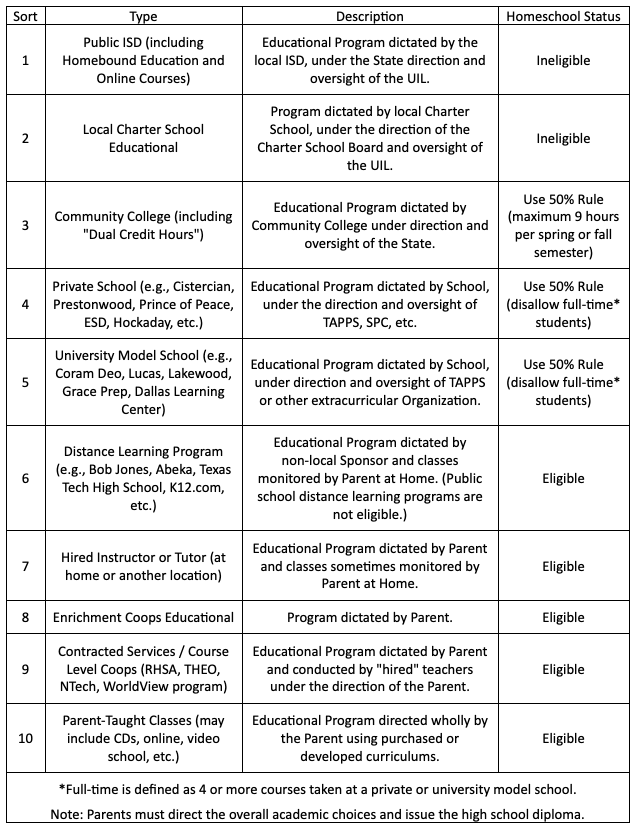
A player must be homeschooled. See the chart “Explanation of How HSAA Interprets Homeschooling” for information on eligibility of various academic programs.
Home schooled students must meet the following academic requirements:
- A player must be living at home with a parent or guardian.
- A player is ineligible if that player is enrolled in more than 9 hours of dual-credit and/or college courses in a semester.
- A player is ineligible if that player has gone through a homeschool, public school, or private school high school graduation ceremony prior to that season's first game. (For some sports, the graduation ceremony must take place AFTER the team’s last game.)
- A player must be passing all courses to participate in a contest or tournament. In performing the role of administrator for the homeschool, the parent is solely responsible for enforcing this rule.
- Parents are required to be involved in directing their student’s education, including:
- Setting requirements for high school graduation (includes State of Texas requirements)
- Choosing course materials, tutors, co-ops, etc. for their students
- Issuing the high school diploma
Sports with Grade-Based Classifications and Designations
For sports following grade-based eligibility requirements, Middle School includes grades 6 through 8; High School includes grades 9 through 12. An athletic grade designation must be declared at tryouts and must conform to HSAA maximum age qualifications. For sports with grade-based classifications, a player shall become ineligible after 4 years of high school participation. Note: An exception is if the HSAA Board approves the participation of an 8th grader on an HSAA high school sub-varsity team, in which case that player is granted 5 years of high school participation. A high school player is ineligible to play on a middle school team. In other words, a ninth grader is prohibited from playing on a middle school team regardless of his or her age. A middle school player is ineligible to play on a high school team, unless the middle school player is prevented from playing on a middle school team due to the age requirement, in which case the middle school player is considered a 9th grader for sports eligibility purposes. In some sports, a 12th grader is prohibited from playing on a sub-varsity team regardless of his or her age. Note: An exception is if the HSAA Board approves the participation of an 8th grader on an HSAA high school sub-varsity team.
Sports with Age-Based Classifications and Designations
Maximum Age Qualifications
A player is ineligible to play on any team on the next September 1st following that player’s 19th birthday. In some sports, a player is ineligible to play on a sub-varsity team or 16U team on the next September 1st following that player’s 18th birthday. A player is ineligible to play on a middle school team on the next September 1st following that player’s 15th birthday. Note that several sports with age-based classifications have a more restrictive (earlier) date.
No player can play more than four years on a varsity or 18U team.
Minimum Grade/Age Qualifications
A player must be in at least the 6th grade AND must be at least 11 years old on September 1st of the current school year in order to participate on a middle school team. Note: Some HSAA sports may require athletes to be in at least the 7th grade and at least 12 years old on September 1st of the current school year.
Transfers and Expulsions
If a player started the season on another homeschool, public, or private school team, no transfer shall be allowed during the season without the approval of the HSAA Board. If a player was expelled from a public or private school during the academic school year or in the year prior, no transfer shall be allowed without the approval of the HSAA Board. A player cannot play on another homeschool, public, or private school team in the same sport at the same time as playing on an HSAA-sponsored team. Playing on a parks and rec team or a select team is allowed, but clear communication with coaches is necessary to make sure that HSAA’s ability to field a team is not impacted.
Exceptions
Exceptions to any eligibility requirement (except age limitations) may be made only by express approval of the HSAA Board. No exceptions will be permitted to the age limitations.
What is the 50% Rule?
For a player to be considered "homeschooled," 50% of his/her education must arrive from at least one of the following sources:
- Class taught at home by parent, grandparent, legal guardian, or an older sibling of at least 18 years of age (may include CDs, online courses, video school, etc.)
- Class taught by hired instructor or tutor (designated by the parent) at home or another location (does not include community college)
- Class at any location where homeschoolers gather to receive contracted educational services from volunteers and/or hired teachers, and where each parent manages the transcript and diploma of the particular student (does not include community college)
- "Distance" learning program, such as Bob Jones, Abeka, Texas Tech High School, K12.com, or other non-local public high school-level correspondence program, as long as the classes are overseen by a parent at home (does not include homebound or online courses administered by a local ISD or charter school)
- Participation on an HSAA sport team (constitutes only 1 homeschool class per semester)
Note: If a student is attending "part-time" at a TAPPS or SPC school, and that school deems the student eligible to participate in their sports program(s), then that student is ineligible for the HSAA sports program. This doesn't apply to schools that already allow homeschoolers to participate on their sports teams.
Revised by the HSAA Board of Directors:
- May 7, 2010 (dual-credit or college hours increased from 8 hours to 9 hours; added Explanation of How HSAA Interprets Homeschooling chart)
- January 29, 2012 (added Minimum Grade/Age Qualifications)
- August 11, 2021 (specified that the dual-credit or college hours limit of 9 hours is per semester, clarified that athletes can play on a select or parks and rec team while playing on an HSAA team, removed UIL from the note under the 50% rule, and included the chart in the document)
- August 13, 2022 (clarified that public school distance learning programs are not eligible)
- August 2025 (clarified age-based vs. grade-based designations)
Explanation of How HSAA Interprets Homeschooling (chart):